A Neighbourhood Restaurant Built On Sourdough, Hospitality And An Owner’s Leap Of Faith
At Dough & Brew, a lively industrial dining room, 72-hour sourdough and an owner’s unlikely journey come together over pizza, beer and a particularly extravagant bowl of mac ’n’ cheese.
W arwick was in a festive mood. Music drifted through streets already crowded with families, visitors and the cheerfully unhurried. The Warwick Folk Festival had filled the town with singers and musicians; strangers gathered around temporary stages, drinks in hand, while the aromas of street food moved through the warm afternoon air.
It was a lovely day—the sort that makes a historic English town feel momentarily like one large neighbourhood party. Beyond the festival crowds, Warwick’s old buildings, narrow streets and hanging flower baskets supplied the scenery. The castle may be the town’s commanding attraction, but on this day, the life of Warwick was happening at pavement level: in melodies overheard around corners, in queues for food and in conversations shared under the summer sky.
A short distance from the busiest part of the centre, Dough & Brew offered its own version of the celebration. Its timber terrace was busy with diners, framed by boxes of vivid pink, purple and red flowers. Above the entrance, a sign made a concise promise: “Pizza & Beer.”
It would be easy to underestimate the restaurant on the strength of that slogan. Inside, however, is a place of considerably greater ambition.
Dough & Brew has the easy sociability of a neighbourhood bar and the visible discipline of a working kitchen. Its interior leans into an industrial vocabulary: exposed concrete overhead, dark block walls, metal stools and lengths of visible pipework. Yet the room never feels austere. Reclaimed timber wraps the bar and kitchen counter; long wooden tables invite groups to sit together; chalkboards covered in hand-drawn lettering introduce a note of mischief.
Highlights
- Sourdough fermented for 72 hours
- Pizzas stretched entirely by hand
- Cooked in a traditional wood-fired oven
- An open kitchen that brings theatre to the dining room
- Rustic industrial design softened by reclaimed timber
- A warm constellation of exposed filament lighting
- House-made burger buns, hot honey and sauces
- Fresh ingredients sourced from local suppliers where possible
- No freezers used in the kitchen
- A recently expanded dining room and craft bar
- An inclusive menu designed with dietary needs in mind
- Silent cinema screenings that make family dining easier
- A welcoming terrace overlooking the Warwick streets
- The Valentina’s hazelnut pesto, buffalo mozzarella, mushrooms and toasted pine nuts
- A gloriously indulgent six-cheese mac ’n’ cheese
- Katie’s journey from local barista to restaurant owner
- A relaxed restaurant shaped by patience, persistence and community
The lighting performs much of the softening. Daylight pours through broad front windows, connecting the dining room to the terrace and the town beyond. From the ceiling, exposed filament bulbs hang at varying heights, casting small pools of amber light across the concrete and wood. The arrangement could have felt overly studied. Instead, the dangling cords and uneven constellation of bulbs suit a room that values personality over polish.
At the centre of it all is the open kitchen. Stainless steel extraction hoods and preparation surfaces gleam against roughly finished timber, while the mouth of the traditional oven glows behind the counter. The kitchen is not hidden backstage; it is part of the set. Cooks stretch dough, monitor the fire and move between workstations in full view of the dining room.
That visibility matters because Dough & Brew’s central argument is one of craftsmanship. Its sourdough contains no commercial yeast and is fermented for 72 hours. Every batch requires the kitchen to anticipate demand three days before the first pizza is ordered. The dough is then stretched by hand and cooked in a wood-fired oven—a method that involves considerably more judgment than simply setting a temperature.
Katie, who runs the restaurant with Tobias, speaks about fire almost as if it were another member of staff: temperamental, demanding and impossible to ignore. Cooking this way requires an understanding of shifting heat, cooler corners and fierce hot spots. The cooks must continually read the oven and reposition each pizza accordingly.
“You’re constantly playing with the fire,” she said. “You’re learning about it.”
Her route to the restaurant was no more conventional than some of its toppings. Years ago, while working as a barista, Katie noticed a returning customer in the queue and prepared his order before he reached the counter: an Americano with skimmed milk and no sugar. He was surprised that she remembered. To Katie, remembering people was simply part of hospitality.
The customer was John, who was preparing to open a restaurant in Warwick. He asked whether she would work for him. Katie laughed and declined. When he returned and asked again, she reconsidered.
“Take the leap of faith,” she remembered thinking. “Why not?”
The job became a passion. When John eventually decided to step away following the difficult Covid years, Katie could not accept that the restaurant’s story might end with his departure. She and Tobias took over, preserving its original foundations while pushing it forward. More recently, after a three-year effort to acquire the adjoining unit, Dough & Brew closed for seven demanding weeks and reopened with a larger dining room, additional seating and an expanded bar.
More beer taps and cocktails may now give the “Brew” half of the name greater prominence, but Katie is clear that food remains the priority.
“We don’t cut corners,” she said. “We make everything ourselves.”
There are no freezers in the kitchen. Ingredients are sourced from local suppliers where possible, and even items that many restaurants would buy ready-made—from burger buns to hot honey—are prepared in-house. Katie describes the objective as “home-cooked food, but you’re at a restaurant”: familiar dishes, made with the care and precision that justify going out for them.
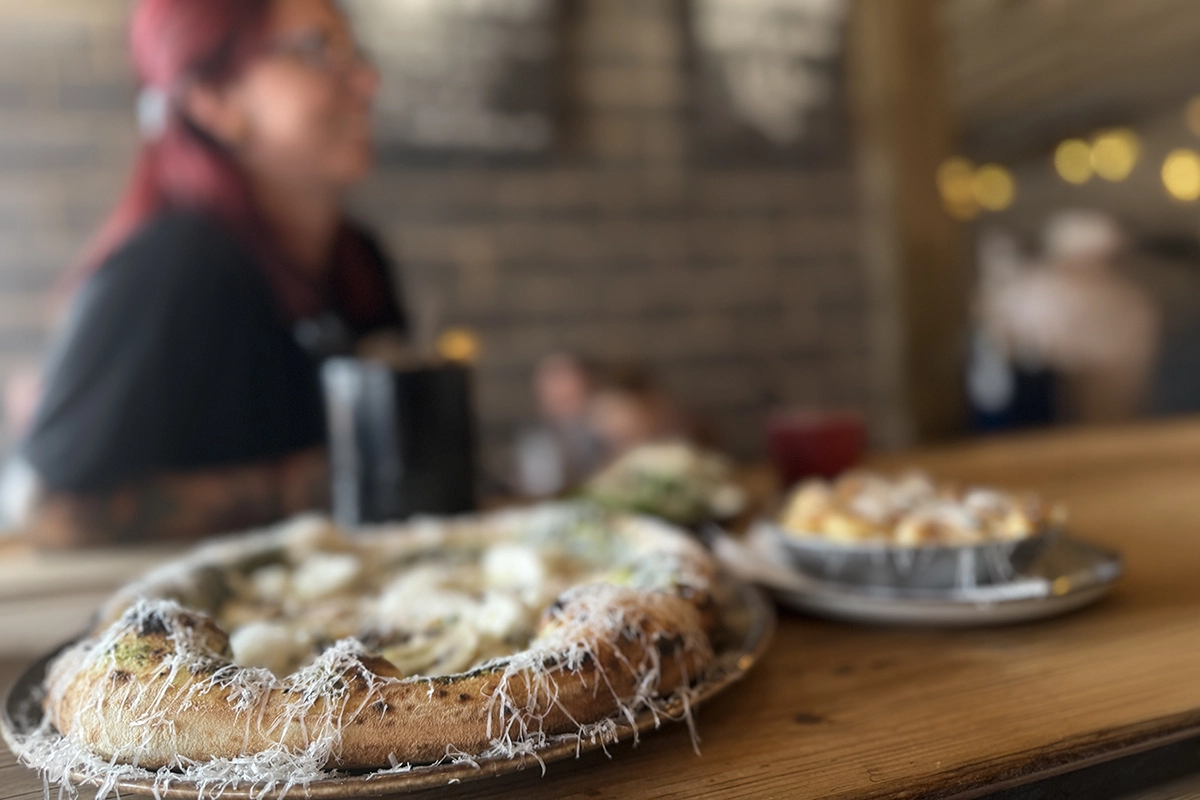
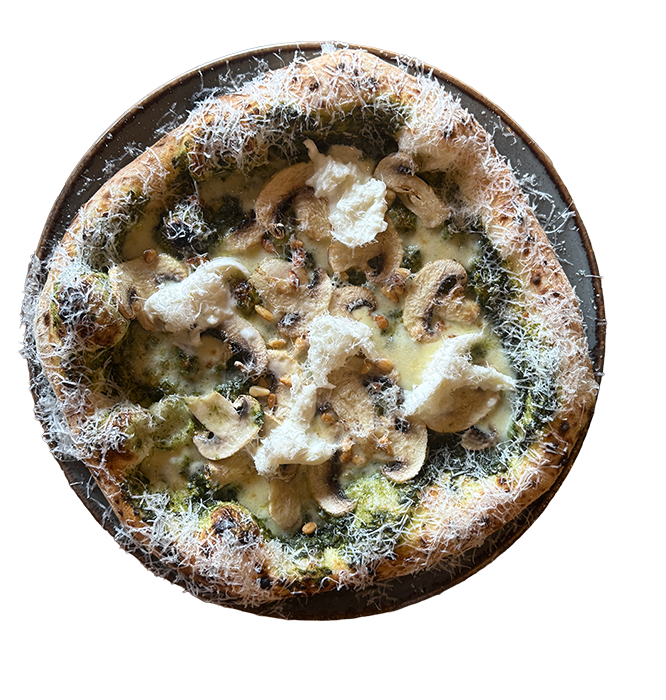
The Valentina pizza demonstrates the idea particularly well. It arrives as an extravagantly rustic composition, its inflated rim blistered and charred in places, surrounding a pale, rich landscape of hazelnut pesto, buffalo mozzarella, toasted pine nuts and sliced mushrooms. It is gloriously indifferent to perfect symmetry. Every bulge and blackened spot along the crust records the fermentation of the dough and its brief encounter with a fierce, living fire.
The crust is not merely transportation for the toppings. It is one of the principal pleasures: crisp at the surface, chewy within and impressively airy around the edges. Its char supplies a faint bitterness and smoky restraint, both necessary against the richness at the centre.
In the absence of tomato, the Valentina must construct its balance differently. Hazelnut pesto provides the foundation, earthy and gently sweet. Fresh buffalo mozzarella rests across it in creamy white pools, while the mushrooms reinforce its woodland savouriness. Toasted pine nuts offer a quieter nuttiness and a welcome point of texture.
The flavours do not announce themselves all at once. They accumulate: first the cool milkiness of the mozzarella, then the mushrooms, basil and roasted nuts, with the smoke of the crust lingering behind them. It is an indulgent pizza, certainly, but also a thoughtful one—traditional in technique and playful in composition. Dough & Brew calls its approach “authentic, with a twist,” and the Valentina makes a convincing case for the phrase.
Restraint plays less of a role in the mac ’n’ cheese, which is comfort food at full volume. Pasta comes submerged in a glorious six-cheese sauce, with added mushrooms and a bubbling, bronze-flecked surface. A snowfall of finely grated cheese and a light scattering of herbs complete the dish.
The mushrooms are a sensible addition, lending an earthy depth to what might otherwise become an uninterrupted procession of cream and cheese. They do not make the dish light—nothing could—but they make its richness more interesting. It is lavish, savoury and unapologetically substantial: ostensibly suitable for sharing, though generosity may falter after the first forkful.
Dough & Brew also attempts a less visible form of hospitality. Katie says the kitchen removes common allergens wherever practical and designs its choices so diners with dietary restrictions are not made to feel like exceptions. Its kitchen menu is prepared to accommodate coeliac diners, while families are welcomed with an inspired detail: a silent cinema allows children to watch a film through headphones while their parents attempt the increasingly rare pleasure of finishing a conversation.
This combination of constituencies could have produced a restaurant without a clear identity. Instead, Dough & Brew feels unusually coherent. It serves local regulars and castle-bound tourists, couples and large families, serious beer drinkers and children wearing headphones. The communal tables, open kitchen and terrace make room for all of them.
Outside, Warwick’s folk festival continued its cheerful occupation of the town. There were more songs to hear, more stalls to investigate and another drink always within reach. Yet Dough & Brew did not feel like an escape from the festival so much as an extension of its spirit: informal, communal and sustained by people who take pleasure in making something for others.
Behind its casual promise of pizza and beer is a restaurant built on patience—the three days required for its dough, the three years spent pursuing the neighbouring unit and the persistence of an owner who entered almost by accident, then chose not to let the place disappear.
Dough & Brew looks relaxed. That relaxation has been hard won. And perhaps that is its most appealing quality: it turns considerable labour into the simple pleasure of a table, a cold drink and a blistered pizza on a lovely day in Warwick.